

Blog
Cleaning Public Spaces: Electric Street Sweeper or Combustion-Engine Machine

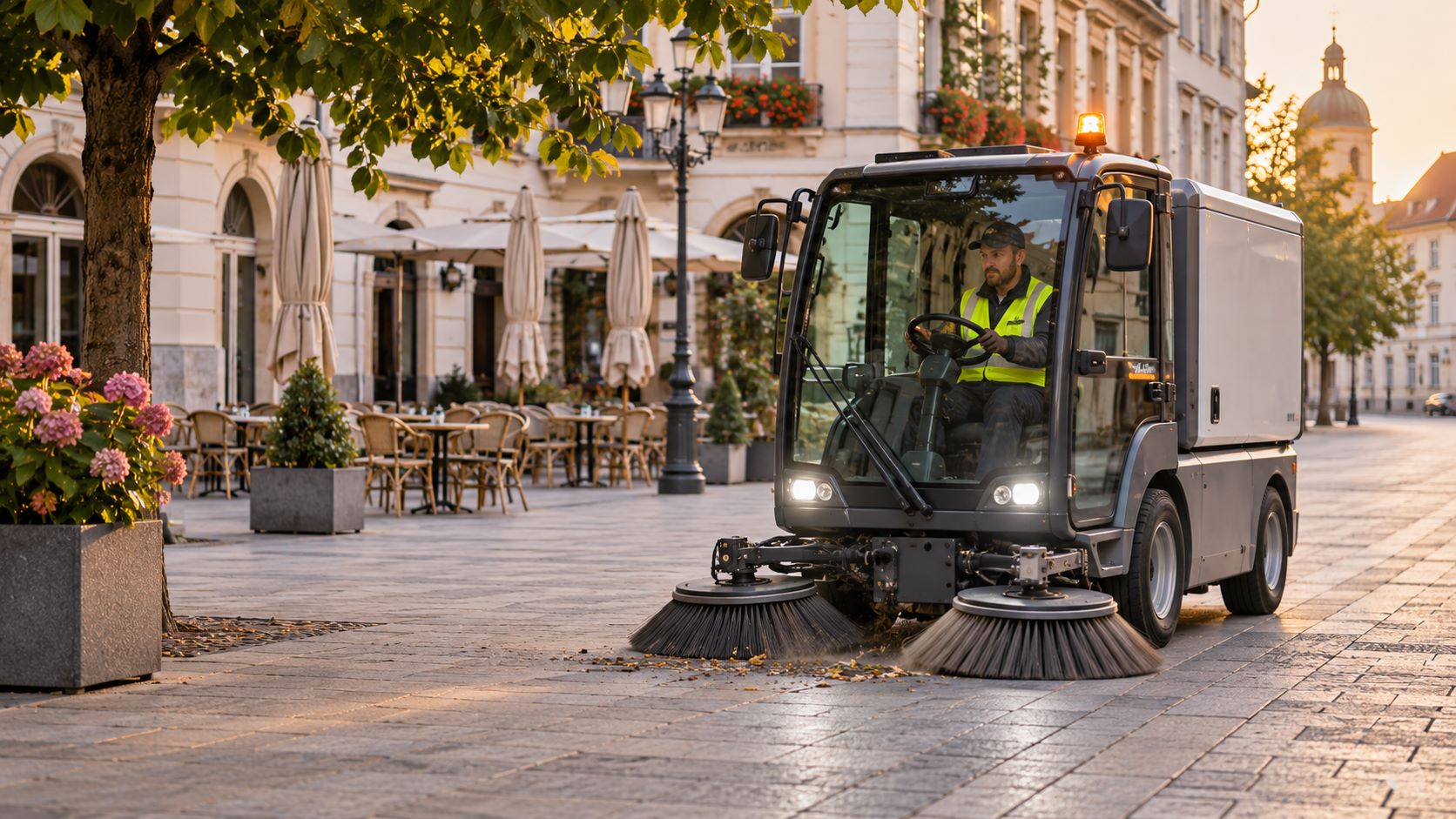
You need to clean a pedestrian area before 7:00 a.m., when the first café terraces open. Or a busy arterial road, where the machine has to cover large areas in a single shift. Both situations call for street sweepers, but not the same one. The first is handled well by an electric machine, with no exhaust emissions at the work site. The second may call for a combustion-engine machine, with a large hopper and fast refuelling.
Choosing between an electric sweeper and one with a combustion engine is not a matter of preference. It depends on the area, working hours, the distance to the emptying point, how the machine is charged or refuelled, and operating costs over several years. A decision based only on the purchase price can cost more than the difference it saves.
In this article we compare the two options on practical criteria. We use data from the product pages of the Komarom range (Dulevo, Green Machines and MP-HT models). We also show when it makes sense to buy, when to rent, and when a refurbished machine is enough. The article is aimed at those responsible for urban and public-space cleaning: city halls, waste management companies, and managers of parks, markets and commercial areas.
How a street sweeper works
A street sweeper collects debris from the roadway, sidewalks and paths into a hopper (also called a container). Side brushes push the debris towards the centre of the machine. The main brushes lift it, and on many models a suction nozzle carries it into the hopper. A water tank dampens the dust so it does not rise into the air.
Models differ in three things that matter at purchase:
- Hopper capacity, in litres. It determines how long you work before the first emptying.
- Autonomy or consumption. On an electric machine, autonomy is the working time on one charge. On a combustion machine, it follows from the tank volume and the hourly consumption.
- Declared productivity, in square metres per hour. This is a maximum value, in continuous work. In the field, stops for emptying, turning and traffic reduce it.
The electric sweeper
The machine is powered by batteries and burns no fuel. It produces no exhaust emissions while working. For your decision, the battery type and the autonomy matter.
Lead-acid batteries are the classic technology. You will find them, for example, on the Green Machines 1ZE (six batteries, 36 V). The MP-HT Wind Zero uses four maintenance-free 6 V/240 A C5 batteries. Lithium batteries appear on the Dulevo D.Zero/2 (LiFePO4) and the Green Machines 400ZE (lithium-ion). In general, lithium batteries need less maintenance than lead-acid ones. Still, check each model’s data in its technical datasheet.
The combustion-engine sweeper
In the Komarom range, these are diesel sweepers. The Dulevo 850 has a 3-cylinder Yanmar engine rated at 44 HP. The Dulevo D6 has a 206 HP IVECO Euro 6 engine. The Euro 6 standard sets strict limits on nitrogen oxides and particulates in exhaust gases.
The main advantage is working volume: large hoppers and refuelling in minutes, not hours. The cost: exhaust emissions, the noise of a combustion engine and the fuel bill. You will find more details about the diesel range in our article on diesel street sweepers.
Electric sweepers: where they show their advantages
An electric sweeper makes sense where distances are short, the hopper does not fill up too quickly and the working environment is sensitive. Below are the situations where the advantages are clearest.
Night work and sensitive areas
Pedestrian zones, parks, markets and areas close to housing are often cleaned at night or early in the morning. Two things matter there: the absence of exhaust gases and the noise level. If noise is a criterion in your tender specifications, request the decibel value from the technical datasheet. The Dulevo D.Zero/2 page, for example, states reduced noise in operation but does not publish a dB value. We do not rely on general claims: we check the data with you before making an offer.
Enclosed or semi-enclosed spaces
Underpasses, covered car parks and covered markets do not have the ventilation of an open space. A machine without a combustion engine removes the problem of exhaust gases. What remains to check is the machine’s size against the manoeuvring space.
Operating costs
Electricity replaces diesel. The maintenance specific to a combustion engine also goes away: engine oil and fuel filter changes. In exchange, there is a cost you need to plan for from the start: batteries have a limited service life and must be replaced. Komarom offers electric street sweepers, as well as batteries, chargers and spare parts, so the replacement cost can be established in advance.
Limits of the electric option
- Autonomy set by the battery. The MP-HT Wind Zero indicates 6 hours, the Green Machines 400ZE indicates 6.5 hours. An 8-hour shift requires a charging break or a second machine for the rest of the shift.
- Small hopper on compact models. The Wind Zero has 210 L, the Green Machines 1ZE has 240 L, and the 400ZE has 284 L. On streets with a lot of debris (leaves in autumn, litter after events), emptying becomes frequent.
- The need for a charging point. The machine needs a suitable power outlet and charging time between shifts. If your depot does not have suitable power, the cost of setting it up must be counted.
Combustion-engine sweepers: when they remain the right choice
A diesel machine is not an outdated solution. On certain routes, it is the only option that covers the work volume without frequent stops.
Large areas and large volumes of debris
The Dulevo D6 has a 6,200 L hopper and a declared productivity of 108,000 m²/hour. The product page also lists two 530 L water tanks (clean and dirty water) and a weight of 9,300 kg. It is a machine for boulevards, arterial roads and extensive areas, where frequent emptying would eat into working time.
The Dulevo 850 sits at a smaller scale: an 850 L hopper, a declared productivity of 22,200 m²/hour, a 47 L fuel tank and consumption of 3.45 L/hour. From these values, the theoretical working time is about 13 hours on one tank. This is an indicative calculation, dependent on the actual working regime.
Fast refuelling
Refuelling takes a few minutes. A machine with a combustion engine can work through a long shift without a charging break. For a waste management company running two shifts, this can weigh more than the difference in noise.
Limits of the combustion option
- Emissions and noise. Even a Euro 6 engine produces exhaust gases and the noise typical of a combustion engine. In some areas, the tender specifications or local rules may restrict night work with such machines.
- Fuel cost. Diesel expenses rise with the number of hours worked.
- Engine maintenance. Periodic oil and filter changes are mandatory and are part of the service plan.
Comparison of models in the Komarom range
The table below puts six models side by side, based on the data published on the product pages. The “-” sign means the value does not appear on the page. For full details, request the complete technical datasheet.
| Model | Drive | Hopper | Autonomy / consumption | Declared productivity |
|---|---|---|---|---|
| Green Machines 1ZE | Electric, lead-acid 36 V | 240 L | 8-16 hours | – |
| MP-HT Wind Zero | Electric, 4 batteries 6 V | 210 L | 6 hours | – |
| Green Machines 400ZE | Electric, lithium-ion | 284 L | 6.5 hours | 10,000 m²/hour |
| Dulevo D.Zero/2 | Electric, LiFePO4 | 2,000 L | 11 hours | – |
| Dulevo 850 | Diesel, 44 HP | 850 L | 3.45 L/hour | 22,200 m²/hour |
| Dulevo D6 | Diesel Euro 6, 206 HP | 6,200 L | – | 108,000 m²/hour |
The figures cannot be compared directly without context. A 2,000 L hopper (D.Zero/2) and a 240 L one (1ZE) serve different situations, even though both machines are electric. Likewise, the D.Zero/2 has a travel speed of up to 40 km/h and a working width of 3,400 mm, which points it towards longer routes than those of a compact machine. Choose the model according to your area and route, not according to the biggest number in the table.
How to choose: questions to ask before purchase
We always start from the area to be cleaned, not from the machine. Five questions settle most of the decision:
- What area do you clean in one shift, and in how many passes? The answer gives the order of magnitude for productivity and hopper size.
- When do you work? If the schedule is at night or near residential areas, noise and emissions become criteria.
- How far is the emptying point? With a small hopper and a long trip to the disposal site, you lose time at every emptying.
- Where is the machine charged or refuelled? An electric machine needs a power outlet and time. A diesel one needs access to fuel.
- How many operators and shifts do you have? An 8-hour shift with a machine of 6 hours’ autonomy calls for a plan: a charging break or another machine.
A worked example shows why autonomy and productivity should be read together. The Green Machines 400ZE declares 10,000 m²/hour and 6.5 hours of autonomy. Multiplied, this gives a theoretical maximum of 65,000 m² on one charge. In practice, the figure drops, because the machine stops to empty, manoeuvres and sometimes works on areas with more debris. If your area is close to this maximum, it is worth choosing a machine with spare capacity or adding a second one. If it is well below it, a compact model is enough. The Dulevo 850 declares 22,200 m²/hour, meaning a much higher working capacity, but with a consumption of 3.45 L/hour.
The next table gives a general guideline. It is confirmed or corrected after analysing the actual site.
| Situation | Guideline | Reason |
|---|---|---|
| Pedestrian zone, cleaned at night | Compact electric | No exhaust, short distances |
| Park with paths, daytime schedule | Compact electric | Small area, emptying point nearby |
| Busy arterial road, long routes | Diesel with large hopper | Volume and fast refuelling |
| City with a historic centre and arterial roads | Mixed fleet | Electric in the centre, diesel on arterial roads |
Buying, renting or refurbished
The business decision matters as much as the technical one. We compare the options, including their limits:
- Buying new. Makes sense for a machine used daily, year after year. The cost per working hour falls as the machine is amortised. The limit: the initial investment is high. Leasing and instalment payments reduce it.
- Renting. Suits seasonal peaks, events or a trial period. You can check in real work whether the type of machine fits, before a large investment. The limit: over the long term, continuous use costs more than a purchase. You will find details about renting cleaning equipment on our website.
- Refurbished machine. A reconditioned machine, brought back to working order. It is enough for moderate use, for a secondary fleet or for a limited budget. The limit: the usage history differs from one unit to another, so ask for information about the machine’s condition and the parts that were replaced.
If you already have old machines, the buy back option (repurchase of worn equipment) and trade in (exchanging them for new models) can reduce the amount you need to invest.
How Komarom helps you in this process
Komarom has worked with professional cleaning equipment since 2008. For street and public-space cleaning, we supply machines from internationally recognised manufacturers such as Dulevo and Green Machines. Our range includes electric street sweepers, combustion-engine sweepers, multifunctional summer-winter street cleaning machines and street vacuum cleaners.
We do not start from the most expensive machine. We start from your space and your work volume. The process usually looks like this:
- Discussion about the site. We find out the area, route, schedule, emptying point and charging or refuelling point.
- Recommendation. We propose the type of machine and explain which space and volume it suits, including its limits.
- Choosing the purchase option. We compare buying, renting, a refurbished machine, leasing and instalment payments.
- Documentation for funding. We offer free consultancy for purchases through SEAP, AFIR and European funds.
- Service and consumables. After purchase, service and technical support, spare parts, batteries, chargers and professional detergents remain available.
For a city hall or a waste management company, a purchase through SEAP has its own documentation requirements. Our free consultancy helps you formulate the technical requirements correctly, so that the tender specifications describe the real need, not a particular model.
Conclusion: electric or combustion-engine street sweepers
There is no single answer that holds for every city or every route. The electric sweeper is the logical choice for pedestrian zones, parks, short routes and night work, where exhaust emissions and noise matter. The combustion-engine sweeper remains suitable for arterial roads, extensive areas and long shifts, where the large hopper and fast refuelling save time. Many cities get a good balance between cost and result with a mixed fleet.
Before deciding, work out how many square metres you clean per shift, how long emptying takes, where the machine is charged or refuelled, and how you will finance the purchase. If you would like us to go through these points together, we invite you to a discussion about your site. You can request a quote or contact us directly, and we will give you a reasoned recommendation, with no obligation.