

Industrial extraction systems
In short: Extraction systems capture dust and fumes directly at the source — at machine tools, welding stations, or packaging lines — before they enter the facility’s air. The category includes 2 models, with total power between 750 and 1100 W.
Extraction systems capture dust and fumes directly at the source — at machine tools, welding stations, or packaging lines — before they enter the facility’s air. This is the most efficient way to maintain a clean working environment and meet occupational health requirements.
The DU-PUY DEDUST range extends from compact DEDUST 1, 2, 4, and 8 units to DEDUST 10 PRO, 30 PRO, and 50 PRO models for heavy-duty industrial applications. Sizing is determined by the number of workstations and the type of emission.
The category includes 2 models, with total power between 750 and 1100 W. Official information about the DU-PUY range: dupuyvacuums.com. Last updated: October 30, 2026.
In short: Extraction systems capture dust and fumes directly at the source — at machine tools, welding stations, or packaging lines — before they enter the facility's air. The category includes 2 models, with total power between 750 and 1100 W.
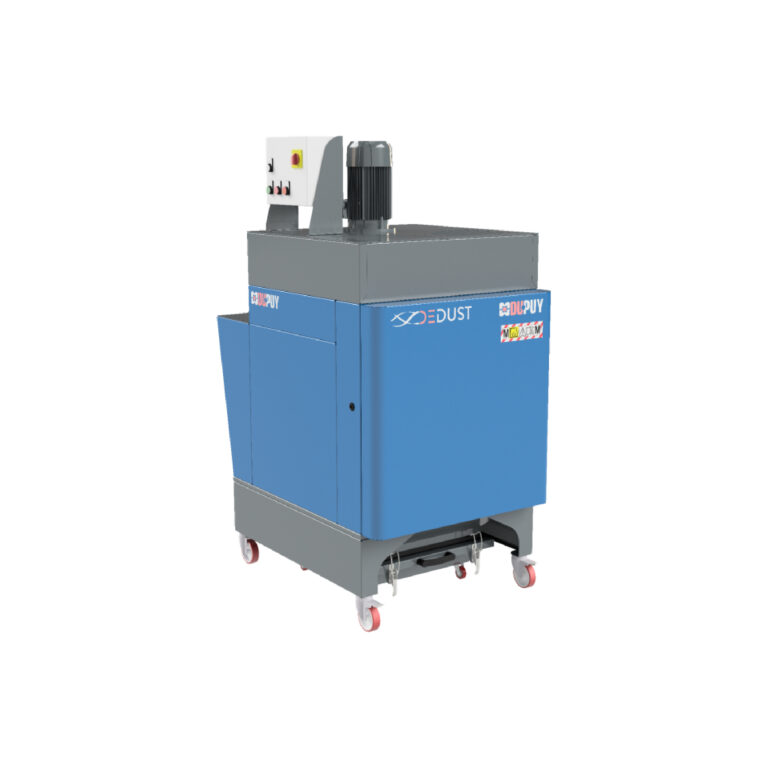
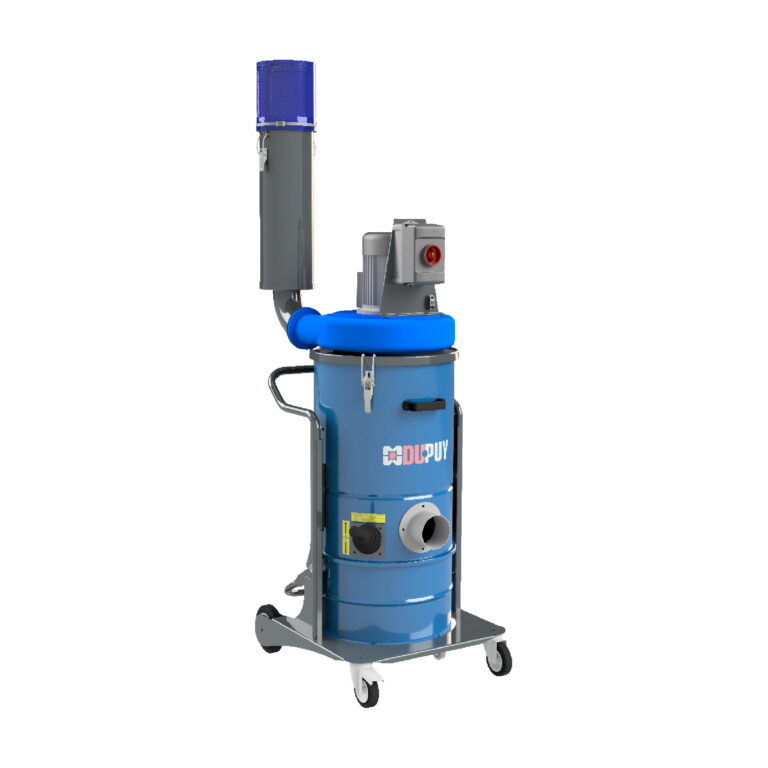
An industrial extraction system is a unit that extracts particle-laden air right next to its source and passes it through a filter that does not allow particles to be released into the environment. The DU-PUY DEDUST range has two families: the compact DEDUST PRO units and the DEDUST 1, 2, 4 and 8 extraction plants.
What is the difference between DEDUST PRO and the DEDUST extraction plants?
DEDUST PRO is mounted directly next to the particle source — a packaging line or a machining centre — and ensures fast extraction of contaminated air. The DEDUST 1–8 plants are built for customers with special extraction needs, such as large air volumes and industrial spaces: depending on size, they can work with several ducts at once and have antistatic class M cartridge filters.
How much air can a DEDUST system extract?
Between 1000 m³/h, on the DEDUST 10 PRO, and 5400 m³/h, on the DEDUST 8. The DEDUST 30 PRO extracts 1300 m³/h and the DEDUST 50 PRO 2700 m³/h; for the plants, airflow is 1350–2100 m³/h on the DEDUST 1, 1350–2400 m³/h on the DEDUST 2, 2100–3800 m³/h on the DEDUST 4 and 3000–5400 m³/h on the DEDUST 8. All models run at 380 V.
How are the filters of a DEDUST system cleaned?
On the DEDUST 2, 4 and 8 plants, the cartridge filters have an automatic compressed-air cleaning system that keeps maintenance to a minimum. The DEDUST 1 has manual cleaning, with optional compressed-air cleaning. The DEDUST 8 has eight cartridge filters, the DEDUST 4 four and the DEDUST 2 two.
Last updated: October 29, 2026.
Frequently asked questions
What does an industrial extraction system do?
Extraction systems capture dust and fumes right at the source, at the machine tool, the welding station or the packaging line, before they reach the air in the hall. This keeps the working atmosphere clean and helps meet occupational health requirements.
Which DU-PUY DEDUST models are available?
The DU-PUY DEDUST range goes from the compact DEDUST 1, 2, 4 and 8 units to the DEDUST 10 PRO, 30 PRO and 50 PRO models for heavy industrial applications. Sizing depends on the number of workstations and the type of emission.
How loud is a DEDUST extraction system?
The noise level is between 68 and 74 dBA. The DEDUST 4 is the quietest model, at 68 dBA, the DEDUST 1 has 69 dBA, the DEDUST 2 and DEDUST 10 PRO have 70 dBA, the DEDUST 30 PRO and DEDUST 8 have 72–73 dBA, and the DEDUST 50 PRO has 74 dBA.
What collection container capacity does a DEDUST system have?
Between 5 and 100 litres. The DEDUST 1 has a 5 L container, the DEDUST 2 30 L, the DEDUST 10 PRO 40 L, the DEDUST 4 and DEDUST 8 90 L, and the DEDUST 30 PRO and 50 PRO 100 L. All containers are made of steel, and the inlet diameter ranges from 100 to 300 mm.
Can you help me choose the right extraction system?
Yes. Through the consultancy service, the Komarom team analyses your specific needs and recommends the right solution. A DEDUST system is sized according to the number of workstations and the type of emission, so we start with an assessment of your hall and then present a detailed proposal.