

Blog
How to Choose Cleaning Equipment for a Warehouse or Logistics Center

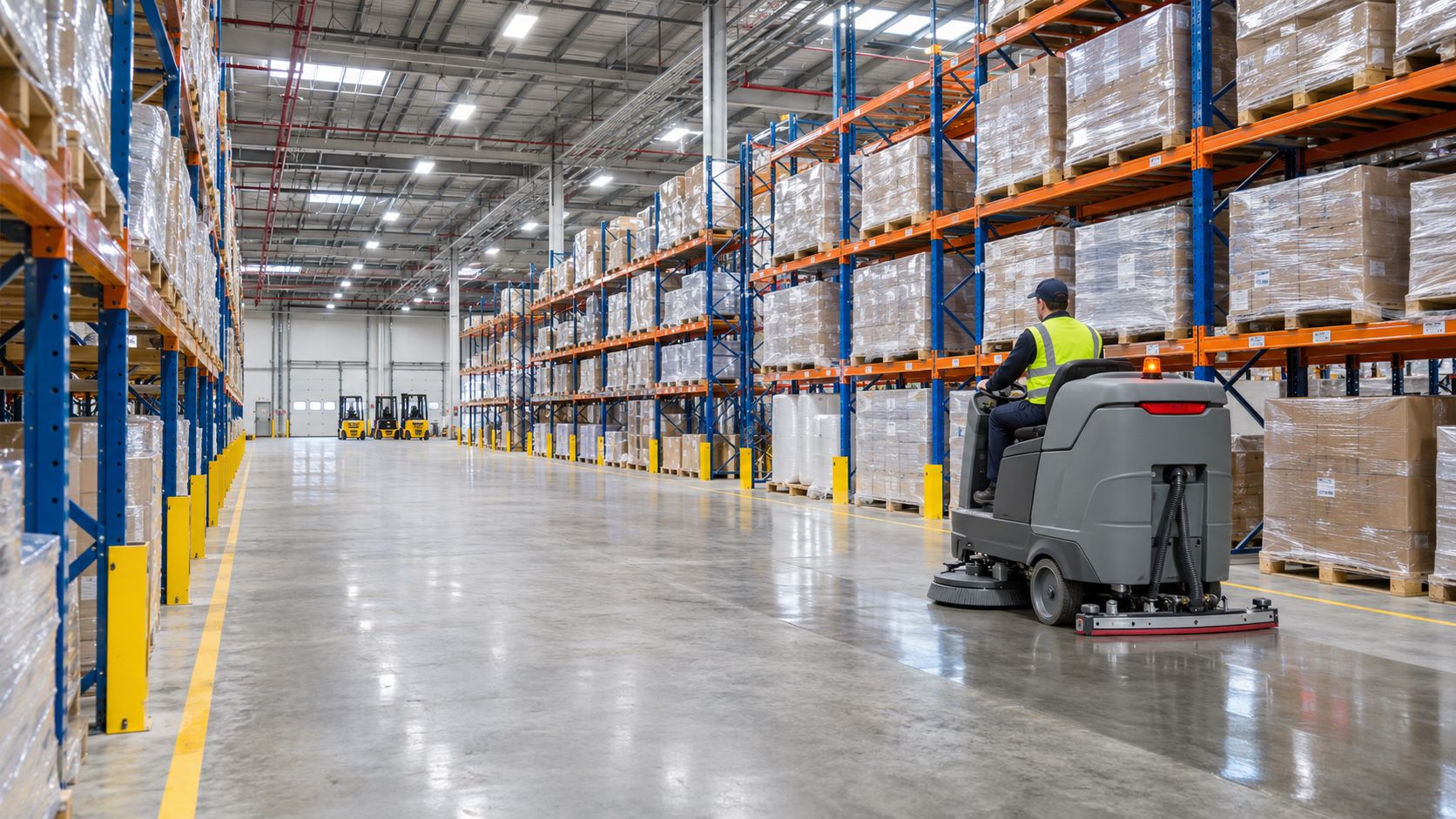
Take a 10,000 m² logistics center running three shifts. Forklifts and electric pallet trucks move almost nonstop, and the loading docks open onto the outdoor yard dozens of times a day. By the end of a week, the floor has collected fine dust, scraps of stretch film, pieces of adhesive tape, pallet splinters and tire marks. At this point, warehouse cleaning is no longer a matter of appearance but an operational one: dust settles on packaging and goods, a dirty floor reduces wheel grip, and the cleaning team has short windows in which to work without disrupting the flow of goods.
Below, we show you how to choose the right equipment for a warehouse or logistics center. We start from your space and your workload, not from the machine.
Why Logistics Cleaning Has Its Own Rules
A warehouse is not cleaned the same way as an office building or a store. A few specific features completely change the choice of equipment:
- Traffic never stops. In many logistics centers there is no “night” when the space is empty. Cleaning has to be planned by zone and built into the shift schedule.
- Aisles between racks vary in width. Main aisles allow a ride-on machine to operate. Narrow aisles between high racks usually require compact, walk-behind equipment.
- Most of the dirt is dry. Dust, sand carried in on truck wheels, and packaging and pallet debris dominate. On top of that, there are occasional spots of oil, hydraulic fluid or rubber marks.
- The space has zones with different requirements. Storage aisles, picking areas, ramps and docks, the battery charging area, the outdoor yard and staff areas (locker rooms, offices) each have a different type of dirt and a different cleaning frequency.
- Warehouse clients have their own requirements. A warehouse that handles food, cosmetics or pharmaceutical goods is audited regularly by its clients, and the condition of the floor and handling areas is part of the assessment.
For these reasons, choosing cleaning equipment for a logistics center usually means several complementary machines, not just one. Learn more about our approach to this sector on the dedicated page for cleaning in logistics, transport and infrastructure.
What Equipment Is Used in a Warehouse and What Each Machine Does
The Sweeper
A sweeper collects dry dirt: dust, sand, film scraps, paper, splinters. It works with brushes that push debris into a hopper, while a suction and filtration system captures fine dust so it is not lifted into the air.
There are walk-behind versions for smaller areas and narrow aisles, and ride-on versions for large areas and main aisles. In a warehouse, the sweeper usually makes the first pass, removing the bulk of the dirt before scrubbing. Manufacturers such as IPC and Dulevo offer professional and industrial sweepers for these spaces.
The Floor Scrubber-Dryer
A scrubber-dryer performs three operations in a single pass: it applies water and detergent to the floor, scrubs the surface with brushes or pads, and immediately vacuums up the dirty water. The floor is left clean and almost dry, and the area can be returned to traffic shortly after the pass.
For a warehouse floor scrubber, a few choices matter:
- Brush type. Disc brushes are suited to fine dirt and maintenance cleaning. Cylindrical brushes can also pick up small debris while scrubbing, which is useful where sweeping beforehand is not always possible.
- Walk-behind or ride-on. The walk-behind version suits narrow aisles and picking areas. The ride-on version suits large areas, where productivity per hour matters more than maneuverability.
- Tank capacity. Large tanks reduce the number of stops for filling and emptying. Stops eat into the cleaning window.
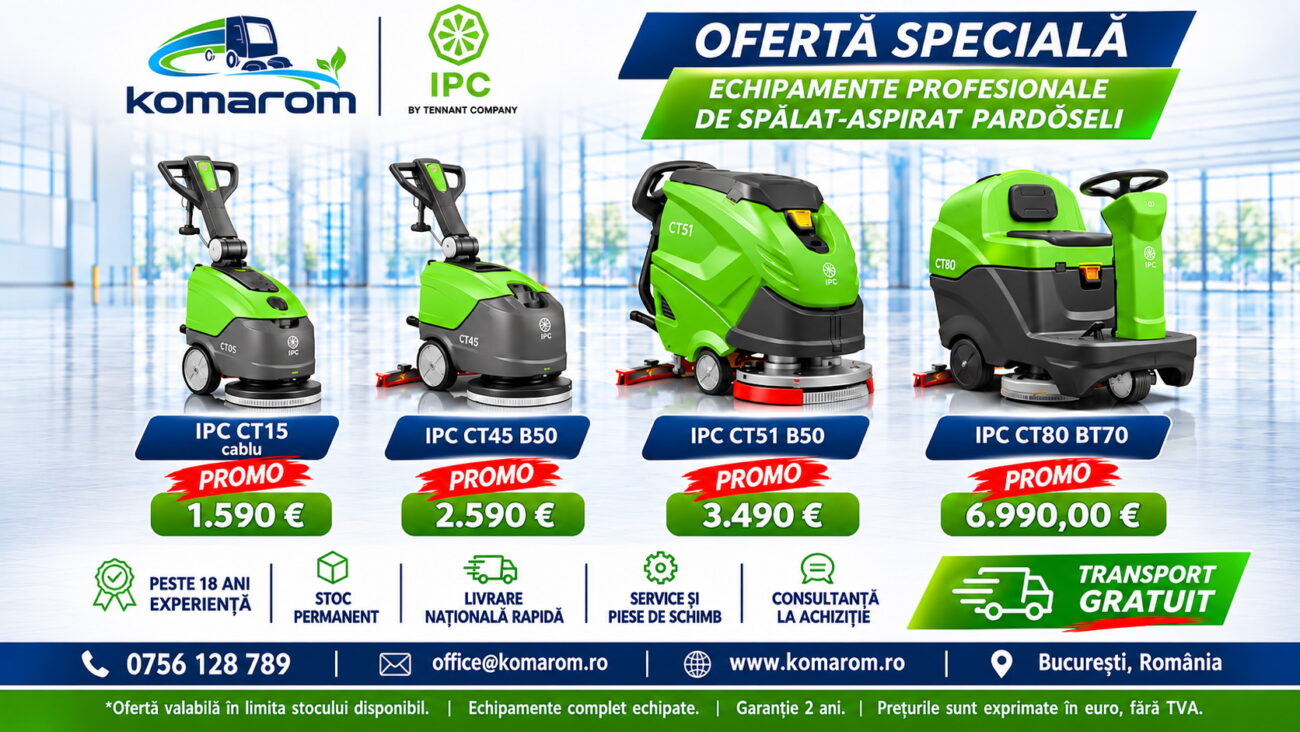
The IPC and Dr. Gansow GMATIC ranges cover both compact models and ride-on machines. The differences between models and the selection criteria are covered in detail in the article on the floor scrubber-dryers offered by Komarom.
Autonomous Floor Cleaning Robots
An autonomous cleaning robot follows a pre-mapped route on its own and avoids obstacles using sensors. In a logistics center, the robot is suited to large, repetitive areas cleaned daily along the same route, especially during low-traffic periods.
It also has limits: very busy areas, aisles frequently blocked by pallets, or heavy dirt still require an operator-driven machine. The robot complements the team; it does not fully replace it.
Industrial Vacuum Cleaners
Floor machines can’t reach everywhere: under racks, in corners, on rack beams, on conveyor belts. This is where industrial vacuum cleaners come in, single-phase or three-phase depending on the workload and the type of debris.
If the warehouse stores flammable substances or produces combustible dust, you need an explosion-proof vacuum cleaner. The term ATEX refers to equipment built and certified to operate in environments with a risk of explosive atmosphere, where an ordinary spark can trigger an incident. Du Puy offers both general-purpose industrial vacuum cleaners and ATEX models.
Pressure Washers
Ramps, loading docks, containers, machine wash areas and outdoor paving are easiest to clean with a pressure washer. A cold-water model is sufficient for mud and dust. A hot-water model is suited to grease, oil and stubborn dirt.
Outdoor Sweepers
The logistics center’s yard, truck parking and access roads collect leaves, sand and packaging debris. That is also where dirt comes indoors from, on the wheels of trucks and forklifts. An outdoor sweeper, electric or with a combustion engine, reduces the amount of dirt entering the building. Dulevo and Green Machines offer models for these surfaces.
Five Questions to Ask Before Choosing a Machine
1. What area do you actually clean, and how often?
Don’t start from the total area of the warehouse, but from the open floor area: aisles, handling areas and ramps. The area occupied by racks is not cleaned by machine.
A machine’s theoretical productivity is easy to calculate: working width (in meters) multiplied by working speed (in meters per hour). For example, a machine with a working width of 0.7 m moving at 4 km/h theoretically covers 2,800 m² per hour. The exact figures for each model are listed on the product sheet.
In practice, actual productivity is lower than the theoretical figure because of turns, stops to empty the tanks, and obstacles. For an accurate calculation, work backward: if you have 6,000 m² of aisles and a 3-hour window, the machine needs to actually cover at least 2,000 m² per hour. With this figure, you can make a fair comparison between models.
2. How wide are the aisles?
Measure the narrowest aisles you need to clean and check the machine’s width and turning radius. A ride-on machine that doesn’t fit between racks leaves part of the area uncleaned, and that part ends up being cleaned by hand.
In many warehouses, the practical solution is a combination: a ride-on machine for the main aisles and a compact walk-behind machine for narrow aisles and picking areas.
3. What type of dirt dominates?
- Dust and dry debris: a sweeper, as the first pass.
- Dust plus stains and tire marks: a scrubber-dryer, possibly with cylindrical brushes, plus a suitable detergent.
- Oil and hydraulic fluid, especially in the battery charging area and near the ramps: a degreasing detergent and, outdoors, a hot-water pressure washer.
Detergent matters as much as the machine. A professional detergent dosed correctly cleans better and is used up more slowly than one dosed “by eye.”
4. How many hours a day does the machine run?
Battery runtime should cover a full cleaning session, with some margin. If the machine works across several shifts, factor in charging time or a spare battery.
The battery type affects maintenance costs. Flooded lead-acid batteries require regular checks and topping up with distilled water. Gel or AGM batteries don’t need this maintenance, but they have a higher upfront cost. The charger must be compatible with the battery type; otherwise, battery life is shortened.
5. Who operates the machine, and when?
Count how many operators you actually have available for cleaning, in which shifts and for how long. A ride-on machine can take over the work of several people using manual equipment, but it requires a trained operator.
If cleaning takes place while warehouse staff are present, also check the noise level on the technical data sheet. A quiet machine can be used during the shift without disrupting communication between operators.
The table below summarizes, by zone, the type of equipment and the main selection criterion.
| Zone | Recommended equipment | Main criterion |
|---|---|---|
| Main aisles | Ride-on scrubber-dryer, sweeper | Actual productivity per hour |
| Narrow aisles and picking | Compact walk-behind scrubber-dryer | Width and turning radius |
| Under racks, corners, conveyors | Industrial vacuum cleaner | Debris type, filtration |
| Battery charging area | Scrubber-dryer with degreasing detergent | Resistance to oils |
| Ramps and docks | Hot-water pressure washer | Stubborn dirt, grease |
| Yard and truck parking | Outdoor sweeper | Area, debris type |
The Concrete Benefits of the Right Choice
Less Dust on Goods
Dust kicked up by forklift wheels settles on packaging and products. For warehouses serving retailers or food manufacturers, dusty goods can lead to complaints and rejections at receiving. Regular sweeping with dust filtration reduces this problem at the source.
Safer Vehicle Traffic
On a floor covered with fine dust, oil or film scraps, forklift wheels have less grip and braking is less predictable. A regularly cleaned floor helps reduce the risk of slipping, for both machines and people.
The Floor Lasts Longer
Sand and hard particles act as an abrasive under loaded wheels. Removing them regularly helps protect the floor’s finish (for example, epoxy coatings) and can postpone resurfacing work.
Predictable Operating Costs
A machine correctly matched to the area reduces the man-hours allocated to cleaning. Water and detergent consumption can be controlled through dosing, and service intervals can be planned. Instead of overtime and “emergency” cleaning before an audit, you have a steady schedule.
Audit Readiness
When cleaning is planned by zone and carried out with the right machines, the condition of the warehouse no longer depends on last-minute effort the day before a client visit. You can document the cleaning frequency and method for each zone.
Buy, Rent or Refurbished: How to Decide
Not every need justifies a new machine. The right decision depends on how often you use the equipment, your available budget and how stable your workload is.
The table below compares the options, including their limitations.
| Option | When it makes sense | Limitations |
|---|---|---|
| New machine | Daily, long-term use, specific requirements | Higher upfront investment |
| Leasing or installment payments | New machine without tying up the budget | Higher total cost than paying in full |
| Rental | Seasonal peaks, relocation, testing before purchase | High cost if extended for a long time |
| Refurbished | Limited budget, moderate use, secondary machine | Limited availability of models |
| Buy back / trade in | You have an old machine to replace | Value depends on the machine’s condition |
A few typical logistics scenarios:
- Peak season. During the holidays or sales campaigns, the volume of goods and traffic increase. Renting a cleaning machine for a few weeks covers the peak without a permanent investment.
- Moving into a new space. Cleaning after construction work or before commissioning a new warehouse is a one-off operation, well suited to rental.
- A second machine. If you already have a main machine and need one for secondary areas or as a backup, a refurbished cleaning machine may be sufficient. Ask which components were inspected and replaced.
- An aging fleet. If your existing machines have high repair costs, the buy back or trade in program reduces the cost of switching to a new model.
For companies purchasing through SEAP or through projects funded by AFIR or EU funds, the technical specifications must be worded correctly from the tender documentation stage. A specification that is too vague attracts unsuitable bids, while one that is too restrictive may be challenged.
How Komarom Helps You Choose Cleaning Equipment for Your Logistics Center
Komarom has been working with professional cleaning equipment since 2008. For a warehouse or logistics center, the process starts from your space:
- Needs analysis. We discuss the open floor area, aisle widths, dirt type, work schedule and number of available operators.
- Machine recommendation. We propose the right combination for your space and workload: for example, a scrubber-dryer for the main aisles, a compact machine for picking and an industrial vacuum cleaner for hard-to-reach areas. We recommend the right machine, not the most expensive one.
- Purchase option. We compare the options with you: new machine, leasing or installment payments, rental, refurbished, buy back or trade in.
- Consumables and power. We supply professional detergents, batteries and chargers compatible with the machines.
- Service and parts. After commissioning, we provide after-sales service and technical support, as well as spare parts.
We work with internationally recognized manufacturers: IPC, Dr. Gansow GMATIC, Dulevo, Green Machines and Du Puy. The range includes scrubber-dryers, sweepers, autonomous robots, industrial vacuum cleaners (including explosion-proof models), pressure washers and outdoor sweepers. This way, you can cover every zone of your logistics center with a single supplier for machines, consumables and service.
For purchases through SEAP, AFIR or EU funds, we offer free consulting: we help you correctly define the technical requirements for the machines based on your actual space and workload.
Conclusion: Warehouse Cleaning Starts with an Analysis of the Space
Logistics cleaning works when each zone has the right equipment and a schedule that fits the shifts. A warehouse floor scrubber chosen based on the actual area, aisle width and dirt type works faster, consumes less and is easier to use than a machine chosen solely on price or size.
If you are equipping a new warehouse, replacing your current fleet, or simply want to check whether your existing equipment matches your workload, we can talk specifically about your space. You can describe your area, schedule and current issues using the cleaning equipment quote request form, and a Komarom consultant will contact you for a conversation, with no obligation.