



Blog
Industrial Vacuum Cleaner or Professional Vacuum Cleaner? Differences and Selection Criteria

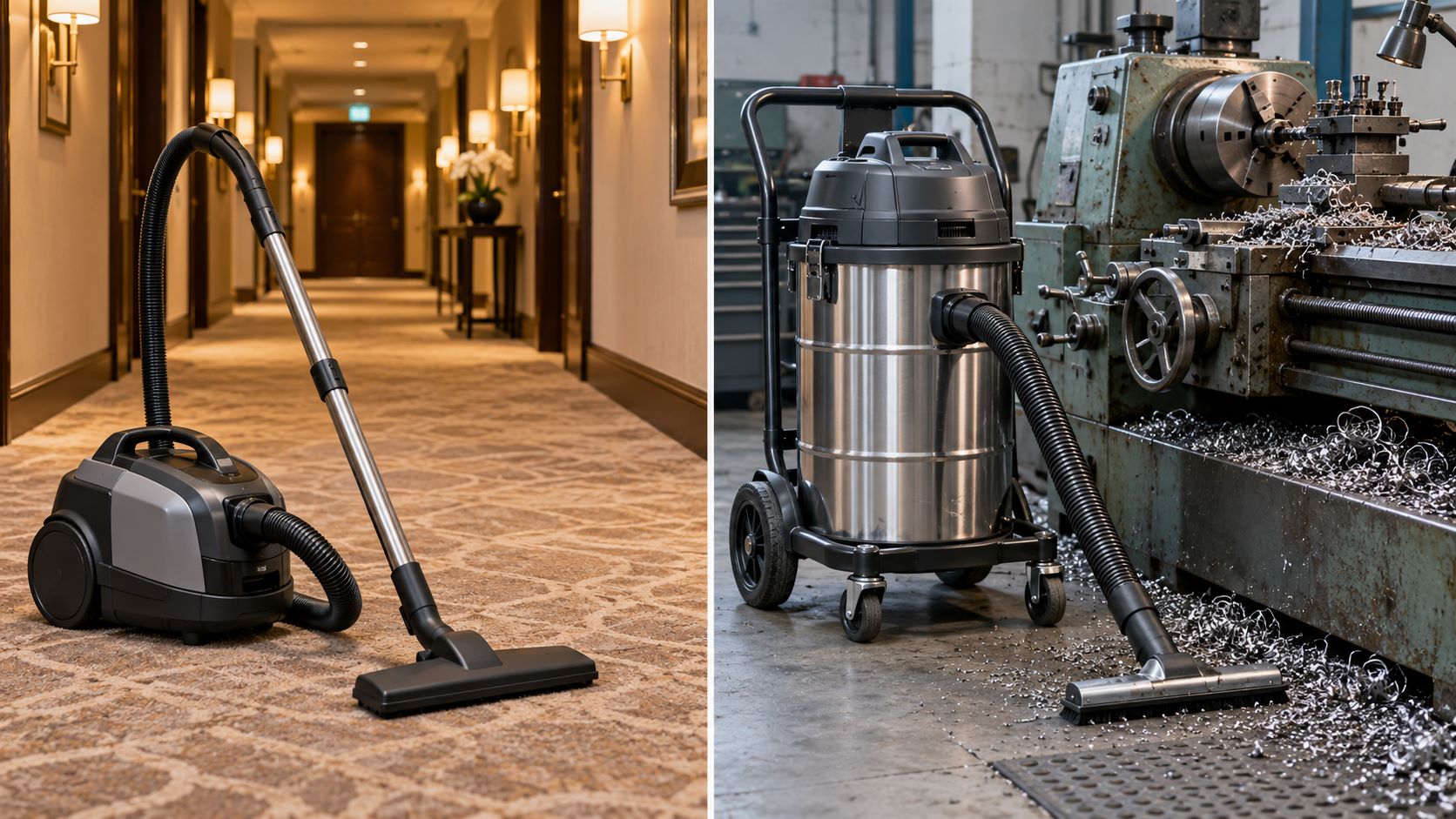
A metalworking shop buys a professional vacuum cleaner to collect the swarf around its lathes. A few weeks later, the filter clogs after every hour of work, the motor overheats and the operators go back to brooms and dustpans. At the other extreme, a hotel chooses an industrial vacuum cleaner for its corridors and rooms. The machine handles any kind of dirt, but it is hard to manoeuvre between furniture and too noisy for the morning shift. Both situations stem from the same confusion: the difference between an industrial vacuum cleaner and a professional vacuum cleaner is not about how powerful the machine is, but about the type of dirt, the duty cycle and the environment it will work in.
In this article we explain what each category means, what the practical differences are and which criteria help you decide which type of machine suits your space and your workload.
What a professional vacuum cleaner is and what an industrial vacuum cleaner is
Both terms describe machines built for intensive use, beyond the level of a household vacuum cleaner. The difference lies in their intended use.
The professional vacuum cleaner
A professional vacuum cleaner is designed for maintenance cleaning in commercial and institutional spaces: offices, hotels, shops, schools, hospitals and event venues. Typical dirt includes dust, fibres, sand carried in on shoes and light debris on carpets and hard floors.
Common features:
- low weight and compact size, so it can be moved easily between floors and rooms;
- single-phase power supply from a standard 230 V socket;
- low noise level, important in spaces that are occupied during cleaning;
- versions for dry vacuuming, for wet and dry vacuuming (labels often show “wet & dry” or “W&D”) and backpack versions for stairs and narrow spaces.
Spray-extraction vacuum cleaners also belong to the professional family. They spray water and detergent into carpet or upholstery fibres and immediately extract it, together with the dissolved dirt. They are useful in hotels, offices and theatres, where dry vacuuming is no longer enough.
The industrial vacuum cleaner
An industrial vacuum cleaner is built for dirt generated by production processes: metal swarf, sawdust, cement and concrete dust, powders, granules, oils and liquids mixed with solids. It often works long shifts, in environments with airborne dust, vibration and changing temperatures.
Common features:
- heavy-duty construction, with tanks and components resistant to impact and abrasion;
- motors sized for continuous operation, in many cases with a three-phase power supply;
- multi-stage filtration and filter cleaning systems;
- special versions: heavy-duty (for large volumes and heavy dirt), explosion-proof (ATEX) and central systems connected to several work points.
For an overview of the ranges designed for production sites and workshops, see the article on DUPUY and UNIVAC industrial vacuum cleaners.
Differences between industrial and professional vacuum cleaners
The table below summarises the main differences. Exact values (power, airflow, vacuum, tank capacity) vary from model to model, so always check them in the product’s technical data sheet.
| Criterion | Professional vacuum cleaner | Industrial vacuum cleaner |
|---|---|---|
| Typical dirt | Dust, fibres, sand, light debris | Swarf, sawdust, powders, liquids, heavy materials |
| Duty cycle | Maintenance, short sessions | Long shifts, sometimes continuous operation |
| Power supply | Single-phase (230 V) | Single-phase or three-phase |
| Filtration | For ordinary dust | Multi-stage, dust classes L, M, H |
| Construction | Lightweight, easy to manoeuvre | Heavy-duty, wear-resistant |
| Typical spaces | Offices, hotels, schools, hospitals | Factories, workshops, warehouses, construction sites |
The type of dirt comes first
A professional vacuum cleaner easily picks up the sand at a shop entrance. Metal swarf, however, has sharp edges and is heavy: it wears out the hose, damages the filter and puts strain on the motor. Very fine powders, such as cement or flour, quickly clog an ordinary filter and reduce suction power. These materials require purpose-designed construction and filtration.
Duty cycle and service life
A professional vacuum cleaner is designed for sessions of a few dozen minutes or a few hours a day, with breaks. Used on a production line for eight hours without interruption, it heats up and wears out much faster than the manufacturer intends. Industrial vacuum cleaners are sized for this kind of duty, and the difference shows in the number of service calls and in the machine’s service life.
Filtration and dust classes
For vacuum cleaners that collect dust hazardous to health, the European standard EN 60335-2-69 defines three dust classes:
- class L (low risk): ordinary, non-hazardous dust;
- class M (medium risk): for example wood dust or mineral dust from processing concrete and stone;
- class H (high risk): dust that is potentially carcinogenic or contains pathogens.
The class shows how well the vacuum cleaner retains fine dust, so that it is not released back into the air. If your premises contain wood, concrete or quartz dust or hazardous substances, the filtration class becomes a safety criterion, not just a performance one. Check the class declared by the manufacturer in the technical data sheet and also ask for the recommendation of your occupational health and safety officer.
Safety in explosive atmospheres (ATEX)
Some seemingly harmless powders, such as flour, sugar, fine sawdust, aluminium dust or certain chemicals, can form an explosive mixture with air at certain concentrations. In such spaces, explosion-proof vacuum cleaners with ATEX certification are used. ATEX is the name of the European regulation for equipment used in potentially explosive atmospheres. Such a vacuum cleaner is built so that it does not produce sparks or heat that could ignite the mixture.
This choice cannot be made by eye. The ATEX zone of the premises is determined through an explosion risk assessment, and the vacuum cleaner must be certified for that specific zone. In the Komarom range, examples of such machines are the DUPUY W2 XR22 and DUPUY W3 INFINI 4KW ATEX explosion-proof vacuum cleaners.
Power supply and mobility
A three-phase vacuum cleaner is usually the choice for continuous operation and heavy loads, but it requires three-phase sockets in the areas where it will be used. Before purchasing, it is worth checking the route: where the sockets are, what cable and hose length is needed, and whether the machine has to be carried up stairs or moved between halls. For this reason, the same product family sometimes comes in both versions, such as the single-phase DUPUY W3 and the three-phase DUPUY W3 INFINI 4KW.
Selection criteria for industrial and professional cleaning vacuum cleaners
The right recommendation starts with a few simple questions. You can note them down before talking to a consultant:
- What are you vacuuming? Ordinary dust, sand and fibres, or swarf, sawdust, fine powders, liquids and oils? Is the dirt dry, wet or mixed?
- How long does the machine work each day? One hour of maintenance in the evening or two production shifts?
- What volume do you collect? If the tank has to be emptied several times per shift, capacity and emptying method matter, for example a tilting tank or a detachable container.
- Is there hazardous dust or a risk of explosion? If so, the dust class and ATEX certification are mandatory criteria, not optional ones.
- What power supply is available? Single-phase everywhere, or three-phase in the halls as well?
- When and where is cleaning done? In hospitals, schools and hotels, noise level and machine size matter as much as power.
- How many vacuuming points do you have? With many machine tools or a long production line, a central vacuum system can be more practical than several mobile vacuum cleaners.
- What is the total cost? In addition to the purchase price, factor in filters, bags, accessories, servicing and the time the machine is out of action for repairs.
Practical examples: which type of vacuum cleaner fits
The table below shows what the choice looks like in a few common situations.
| Space and situation | Recommended type | Main reason |
|---|---|---|
| Hotels, offices, conference rooms | Dry professional, plus spray-extraction for carpets | Manoeuvrability, low noise |
| Hospitals, schools | Professional, with suitable filtration | Hygiene, work in occupied spaces |
| Metal or woodworking shop | Heavy-duty industrial | Heavy dirt, long shifts |
| Factory with combustible powders | ATEX explosion-proof | Safety and compliance |
| Hall with many workstations | Central vacuum system | One system, several points |
| Warehouse, machinery maintenance | Wet and dry industrial | Dust, debris, accidental spills |
Hotels and office buildings
The dirt is light, but the area is fragmented: rooms, corridors, stairs, meeting rooms. A lightweight professional vacuum cleaner, possibly a backpack model for stairs, lets the operator move quickly from one space to another. For carpets in high-traffic areas, periodic spray-extraction cleaning complements daily vacuuming. You can find examples of machines for these spaces in the article on IPC professional vacuum cleaners.
Hospitals and schools
Cleaning is often done while the spaces are occupied. Noise level, compact size and filtration that does not release dust back into the air all matter. In most cases, a well-chosen professional vacuum cleaner is enough. An industrial vacuum cleaner would be oversized and harder to use in corridors and classrooms.
Workshops
Swarf, sawdust and cutting dust call for an industrial vacuum cleaner with heavy-duty construction and filtration suited to the dust class. For large volumes and intensive daily work, there are heavy-duty vacuum cleaners such as the UNIVAC BL15AV.
Factories with combustible powders
Mills, bakeries, aluminium processing shops and chemical plants usually have ATEX-classified zones. Here, an explosion-proof vacuum cleaner is a safety requirement, and the recommendation is based on the zone determined in the risk assessment.
Halls with many workstations
When several operators generate dust at different machines, moving a mobile vacuum cleaner from one station to another takes time. A central system, such as the UNIVAC SV heavy-duty central vacuum cleaner, collects dust from a network of points connected to a single unit.
The benefits of the right choice
The difference between a correctly chosen machine and one chosen on power alone shows in costs and in how work is organised:
- Less downtime. A machine sized for the actual duty cycle breaks down less often. Every day the vacuum cleaner spends at the service centre means cleaning is postponed or done by hand.
- Lower total cost. A professional vacuum cleaner used in production may cost less upfront, but it uses up more filters and parts. An industrial vacuum cleaner used in an office means paying for capabilities you do not need.
- Productivity. A machine suited to the space reduces cleaning time: fewer tank emptyings, less time spent unclogging filters, easier handling.
- Operator health. Proper filtration reduces the fine dust employees breathe in, especially in workshops and on construction sites.
- Compliance. In spaces with an explosion risk or hazardous dust, the right equipment is part of the occupational safety measures checked during inspections.
Signs that your current vacuum cleaner is no longer suitable
- the filter clogs several times per shift;
- the motor overheats or cuts out during work;
- the hose and accessories wear out or crack quickly;
- operators avoid the machine because it is hard to move or empty;
- new materials (powders, liquids, oils) have appeared in the process that the machine was not designed for.
Buy, rent or choose a refurbished machine?
Not every need justifies a new purchase straight away.
Buying makes sense when the vacuum cleaner is used daily, over the long term, and the requirements are clear. With leasing or instalment payments, the investment can be spread over time.
Renting suits temporary needs: post-renovation cleaning, a project lasting a few weeks, or testing a type of machine before deciding to buy. You can find details on the cleaning equipment rental page.
A refurbished machine may be enough when the budget is limited and use is moderate. It is worth reviewing with a consultant, depending on the models available at the time.
If you already have a machine that no longer meets your needs, buy-back and trade-in options let you recover its value when switching to a new model.
How Komarom helps you choose the right vacuum cleaner
Komarom has been working with professional cleaning equipment since 2008. From our experience with clients in industry, healthcare, education, HoReCa and public administration, we have seen that the costliest mistake is not an expensive machine, but an unsuitable one.
Specifically, we help you as follows:
- Needs analysis. We discuss the type of dirt, working hours, the environment (including ATEX and dust classes), the power supply and the number of operators. We recommend the type of vacuum cleaner suited to your space and workload, not the most expensive one.
- Ranges for both categories. For maintenance cleaning, we work with IPC professional and spray-extraction vacuum cleaners. For production sites and workshops, we offer DU-PUY industrial vacuum cleaners, including explosion-proof versions, as well as UNIVAC heavy-duty models and central systems.
- Purchase options. Sale of new machines, refurbished machines, rental, leasing and instalment payments, buy-back and trade-in.
- After delivery. Spare parts, consumables (filters, bags, accessories) and after-sales service, so the machine stays operational throughout its service life.
- Public procurement and funding. For municipalities, hospitals, schools and companies purchasing through SEAP, AFIR or EU funds, we provide free consultancy on defining technical requirements and documentation.
Conclusion: choose based on dirt, duty cycle and environment
Choosing between an industrial vacuum cleaner and a professional vacuum cleaner is not a matter of maximum power. A professional vacuum cleaner is suited to maintenance cleaning in offices, hotels, schools and hospitals, where manoeuvrability and low noise matter. An industrial vacuum cleaner is needed wherever there is swarf, sawdust, fine powder, liquids, long shifts, hazardous dust or a risk of explosion.
Before deciding, note what you vacuum, how long the machine works, what power supply you have and whether the space has special safety requirements. With this information, the recommendation becomes simple and easy to verify.
If you would like to review your situation together, you can request a quote for cleaning equipment or describe your space and workload to us. We will recommend the right option, including when renting or a refurbished machine is enough.


