



Blog
Floor Scrubber Dryer: How to Choose the Right Model Based on Surface Area and Type of Space

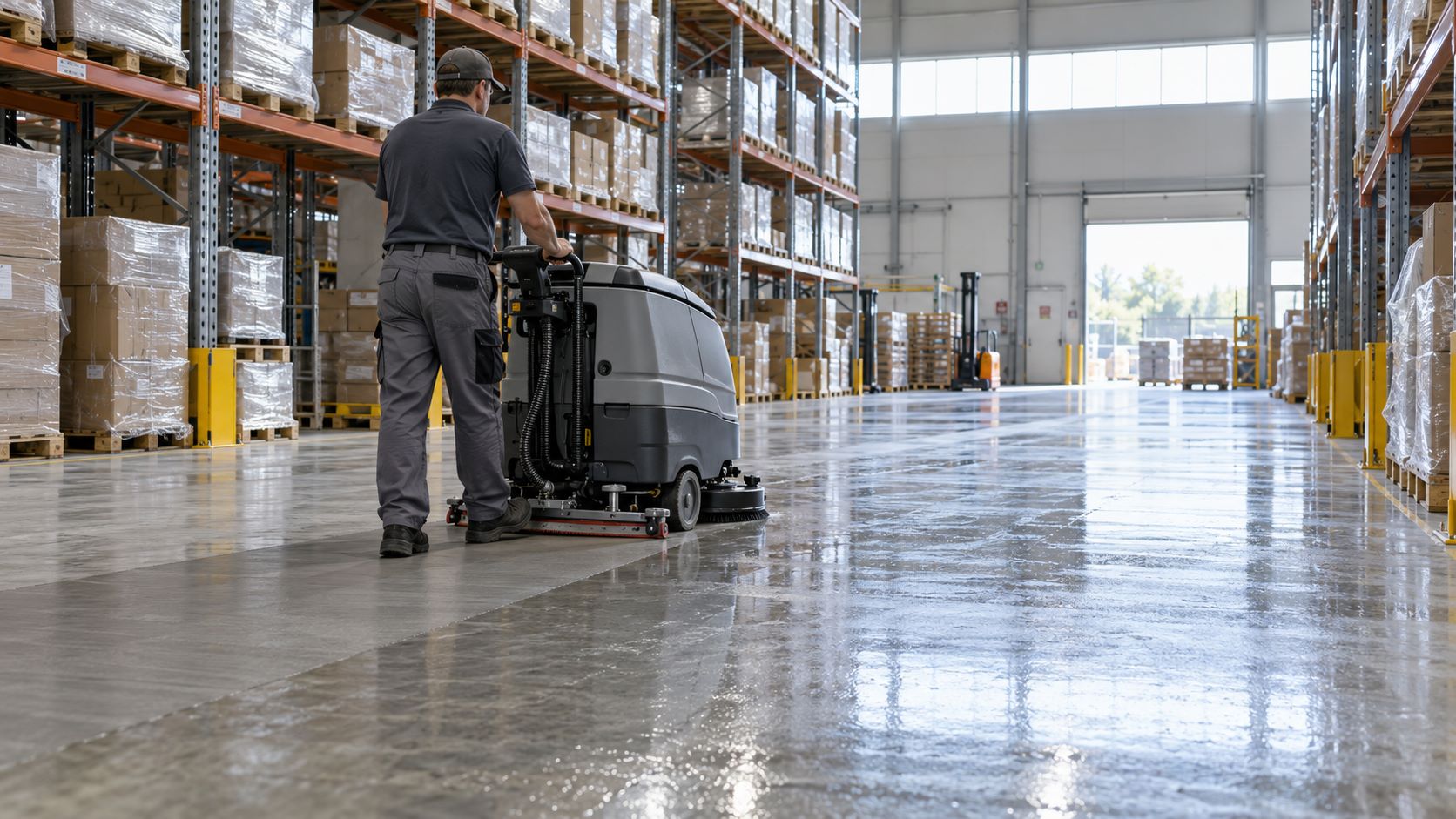
Do you have to maintain a 5,000 m² warehouse, a supermarket with extended opening hours, or an office lobby that must be ready before 7:30? When you choose a floor scrubber dryer, these facts are your starting point: the surface area, the schedule and the way people move through the space. The size of the largest model in the catalogue is not.
A floor scrubber dryer is a machine that washes the floor and dries it in the same pass. Brushes loosen the dirt, and a vacuum motor recovers the dirty water. The data sheets of these machines contain dozens of figures, and only some of them matter for your space.
This guide walks through the criteria that matter when choosing a floor scrubber dryer: productivity, working width, tanks, autonomy and noise. We use five models from the Komarom range as examples, with the values from their data sheets. At the end we compare buying, renting and refurbished machines, because professional cleaning equipment is chosen on total cost as well, not only on the data sheet.
How a floor scrubber dryer works
The term “scrubber dryer” describes two operations done at the same time. The machine applies a cleaning solution to the floor, scrubs it with brushes or pads and immediately recovers the dirty water. The recovery is done by the squeegee, a rubber blade mounted at the back of the machine, which gathers the water in front of the vacuum motor.
The components that influence the choice
- The solution tank (clean water with detergent) determines how long you can work without stopping to refill.
- The brushes and their pressure on the floor determine how well the dirt is loosened. The IPC CT71, for example, has two 350 mm brushes.
- The squeegee and the vacuum motor decide how dry the floor is after the pass. On the IPC CT71 the squeegee is 1,010 mm wide.
- The recovery tank (dirty water) has to be emptied periodically. On the same model, both tanks hold 70 L.
Walk-behind or ride-on
Walk-behind machines are steered by walking behind them. They are lighter and easier to manoeuvre, so they suit spaces with shelving, furniture or tight corners. Ride-on machines carry the operator, who drives while sitting or standing on the machine, so operator fatigue is lower on very large surfaces. The Dr. Gansow Rotan 155BTX95 is described on its product page as a ride-on machine for very large surfaces, with a maximum travel speed of 9 km/h.
Battery-powered or corded
Battery-powered models do not depend on sockets and can cover long routes, but their autonomy is limited and the batteries have to be charged between shifts. Corded models can work without a time limit, but the cable restricts the route. The Nilfisk SC450 exists in both versions: the SC450 B, battery-powered with a maximum working time of 3 hours, and the SC450 E, powered at 220 V.
How to choose a floor scrubber: five criteria
1. Surface area and productivity
Productivity is expressed in square metres per hour (m²/hour). The figure in the data sheet is a maximum, calculated for continuous travel. For the Nilfisk SC450 B, a scrubbing width of 530 mm and a maximum speed of 4 km/h give 2,120 m²/hour, exactly the figure in the data sheet. For the IPC CT71, 700 mm and 4.5 km/h give 3,150 m²/hour.
In practice, the operator turns the machine, goes around obstacles, and fills and empties the tanks. Actual productivity is lower than the data-sheet figure. Use the figure to compare models with each other, not as a promise of a work schedule.
Take the example of a 5,000 m² hall. Divide the surface area by the maximum productivity and you get the minimum working time:
- about 2 hours 20 minutes with a 2,120 m²/hour model (Nilfisk SC450 B);
- about 1 hour 35 minutes with the IPC CT71 (3,150 m²/hour);
- about 50 minutes with the IPC CT160 (6,175 m²/hour).
If the hall is cleaned at night, in a three-hour window, the first model leaves a small margin, the second a comfortable one and the third a large one. The right question is not “how big is the machine” but “how much surface do we have, in how much time and with how many operators”.
The same calculation works in reverse for small surfaces. For an 800 m² office lobby, the minimum time is about 15 minutes with the IPC CT71 and about 23 minutes with a 2,120 m²/hour model. At that size productivity no longer decides the choice. Manoeuvrability, noise and tank capacity matter more, and a machine rated above 6,000 m²/hour would be an investment you do not use.
2. Working width and manoeuvring space
A wider path covers more in a single pass but needs wider aisles. Between the shelves of a supermarket or in a narrow corridor, a compact machine works better than a large one. Compare weight as well: the IPC CT71 weighs 185.3 kg, while the IPC CT160 weighs 752 kg. If your route includes ramps or slopes, check the maximum gradient in the data sheet.
3. Tanks and autonomy
The tanks determine how long you can work without stopping to fill and empty them. Autonomy, meaning the working time on a full battery charge, determines how long you can work without recharging. The Nilfisk SC450 B has tanks of 40 L and 45 L and up to 3 hours of operation. The IPC CT71 has 70 L tanks and 3.5 hours of autonomy. The Rotan 155BTX95 has 155 L for each tank and 7 hours of operation. If the machine works several hours in a row, autonomy becomes the main criterion.
4. Noise and working hours
In office buildings, schools, hospitals or hotels, cleaning is often done while people are in the building. In that case the noise level matters, expressed in dBA (decibels weighted to the sensitivity of the human ear). The IPC CT71 declares 58 dBA. The Nilfisk SC450 B declares 68 dBA, measured at 1.5 m, and the Gmatic 70BTX73 and the Rotan 155BTX95 declare 69 dBA. The IPC CT160 has 72 dBA. Measurement conditions can differ, so compare the figures with caution and, if needed, ask for a demonstration.
5. The floor and the type of dirt
The floor (tile, concrete, resin, PVC, or the floor of a professional kitchen, where grease makes it slippery) determines the type of brushes and the cleaning solution. The dirt determines whether the machine needs a sweeping pass before scrubbing: sand and large solid debris are hard for the brushes of a scrubber to collect. Describe your floor to us and we will tell you which configuration makes sense.
Total cost of use and common mistakes
The purchase price is only part of the cost. The total cost includes the batteries, which wear out and have to be replaced, the brushes, the squeegee blades, the detergent, service and spare parts. Before you decide, check that parts and service are available for the model you have chosen.
Four mistakes appear often when choosing:
- choosing by working width, without checking the aisles and the turning space;
- ignoring autonomy, although the machine will work several hours in a row;
- comparing noise or productivity figures measured under different conditions;
- buying a large machine for a small surface, just for “spare capacity”.
Five models, compared by their data sheets
| Model | Working width | Maximum productivity | Tanks (clean / dirty) | Autonomy | Noise | Suited for |
|---|---|---|---|---|---|---|
| Nilfisk SC450 B | 530 mm | 2,120 m²/hour | 40 L / 45 L | 3 hours | 68 dBA | Medium surfaces: offices, shops, warehouses, halls |
| IPC CT71 | 700 mm | 3,150 m²/hour | 70 L / 70 L | 3.5 hours | 58 dBA | Medium-sized commercial and industrial spaces |
| Dr. Gansow Gmatic 70BTX73 | 730 mm | 2,835 m²/hour | 70 L / 70 L | 4 hours | 69 dBA | Warehouses, logistics, supermarkets, car parks |
| IPC CT160 | 920 mm | 6,175 m²/hour | 145 L / 170 L | 5 hours | 72 dBA | Large spaces, heavy-duty machine |
| Dr. Gansow Rotan 155BTX95 | 950 mm | 6,800 m²/hour | 155 L / 155 L | 7 hours | 69 dBA | Very large surfaces, ride-on operator |
The values come from the data sheets on the product pages and should be checked before you decide. “Heavy-duty” means built for intensive use.
Commercial and industrial cleaning: which model fits which space
Every type of space raises different problems. Below you will find what to look for in each case and what you gain in practice by choosing correctly.
Shops, supermarkets and shopping centres
Here there is constant customer traffic and extended opening hours. Cleaning has to be quick, and the floor has to be dried immediately, for customer safety. The Komarom page on equipment for commercial spaces, offices and HoReCa (hotels, restaurants and catering) lists compact models for this segment, such as the IPC CT15, IPC CT51 and Nilfisk SC351, for aisles and shopping galleries.
The practical gain: fewer blocked areas while cleaning is under way and a lower risk of slipping, because the dirty water does not stay on the floor.
Offices, schools and medical facilities
Cleaning is done outside working hours or in periods of reduced activity, and hygiene requirements are stricter, especially in a hospital. Low noise and recovery of the dirty water matter more here than maximum productivity. The IPC CT71 declares 58 dBA, has a working width of 700 mm and 70 L tanks. Its product page describes it for medium-sized commercial and industrial spaces. The choice of detergent or disinfectant remains with the facility’s hygiene protocol: the machine applies the solution and recovers it.
Hotels, restaurants and professional kitchens
Lobbies and dining rooms call for a manoeuvrable, low-noise machine, while kitchens have greasy, slippery floors. A single machine does not always cover both situations equally well. A compact model for the dining room and a dedicated solution for the kitchen can be a better fit than a single model. Tell us what the daily flow looks like and we will analyse it together.
Warehouses, halls and logistics centres
Large surfaces, forklift traffic and work in shifts: productivity and autonomy matter. The Dr. Gansow Gmatic 70BTX73 is recommended on its page for warehouses, logistics centres, production halls, supermarkets and car parks, with 2,835 m²/hour and 4 hours of autonomy. For larger surfaces, the IPC CT160 reaches 6,175 m²/hour, and the ride-on Rotan 155BTX95 reaches 6,800 m²/hour and 7 hours of work. In theory, with these last two models a single operator covers a 5,000 m² hall in under an hour.
What you gain in practice by choosing correctly
- Time: the same space is cleaned in a shorter interval or with fewer operators.
- Safety: areas are closed off for less time and the risk of slipping decreases.
- Controlled costs: you do not pay for capacity you do not use, and water and detergent consumption stays proportional to the space.
- Predictability: you know from the data sheet what autonomy, what tanks and what noise level to expect.
Buying, renting or refurbished: what suits your business
After the model comes the business decision. Each option has advantages and limits.
New machine
This is suitable when the machine works every day, for many years, and the configuration has to match the space exactly. The initial investment is the highest. Leasing or instalment payments spread it over time, but the total cost depends on the contract terms, so compare it with the price of a direct purchase.
Rental
Renting suits seasonal needs, a deep clean after construction work, or testing a model before buying. If the machine works every day, it is worth comparing the cumulative rent with the cost of a purchase. The details of the service are on the page for cleaning equipment rental.
Refurbished machine
A refurbished (reconditioned) machine generally has a lower entry price and covers a moderate work schedule well. The limit is its history: find out what was checked and what was replaced before you decide. For a machine used intensively, several hours a day, a new model may be the safer choice.
If you already have an old machine, buy back (the repurchase of used equipment) or trade-in (exchanging it for a new model) can reduce the amount you need to invest.
How Komarom helps you choose the right machine
We have been working with professional cleaning equipment since 2008. For floor scrubber dryers, our range includes IPC, Nilfisk and Dr. Gansow GMATIC, so we compare models from several ranges, not from a single catalogue. In practice:
- Space analysis. You tell us the surface area, the type of floor, the schedule and the number of operators. We recommend the machine that suits the space and the volume, not the most expensive one.
- Demonstration. We can arrange a demonstration of the solution before implementation.
- Staff training. Operators learn how to use the machine correctly.
- Service, parts and consumables. After-sales technical support, spare parts, professional detergents, batteries and chargers.
- Purchase options. Sale of new machines, refurbished machines, rental, leasing and instalment payments, buy back and trade-in.
- Funding. Free consultancy for purchases through SEAP (the Romanian Electronic Public Procurement System), AFIR (the Agency for Rural Investment Financing) and European funds.
Conclusion: choose by surface area, schedule and total cost
Choosing a floor scrubber takes three steps. First calculate the working time from the surface area and the maximum productivity in the data sheet, then correct it for the reality on site. Next check the manoeuvring space, the autonomy, the tanks and the noise. Finally compare buying, renting and a refurbished machine according to how often you will use the floor scrubber dryer. For cleaning commercial spaces, offices or halls, this order avoids both a machine that is too small and one paid for with capacity you will not use.
If you would like to discuss your situation, send us the approximate surface area, the type of floor and the working schedule. We will reply with a recommendation and, where appropriate, an option for a demonstration. A conversation does not oblige you to anything, and it helps you rule out the models that do not fit. Contact the Komarom team when you are ready.


