

Blog
Industrial Hall Cleaning: Which Equipment to Choose for Dust, Debris and Heavy Traffic

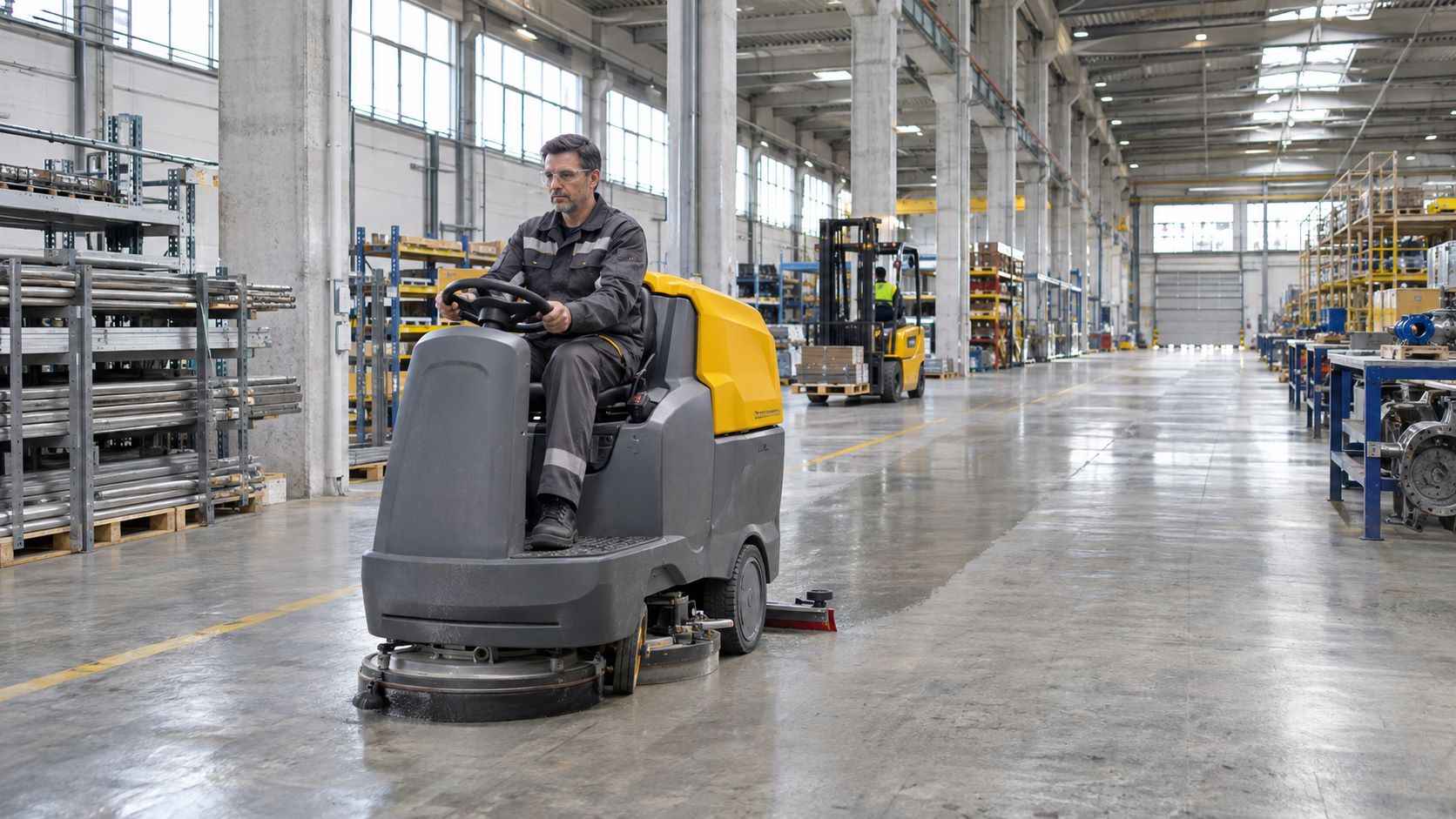
A 5,000 sq m production hall runs two shifts. Forklifts travel the same aisles all day, and at the end of each shift the floor holds fine dust, metal chips, packaging scraps and traces of oil. The cleaning team has an hour, a broom and a mop. The outcome is predictable: the dust moves from one place to another, rises into the air and settles again on the machinery, while the oily areas stay slippery.
This is the real situation in many factories, material warehouses and workshops. Industrial hall cleaning is not solved with extra labor. It is solved with equipment suited to the type of dirt, the surface and the work schedule. In this article we go through three frequent problems (dust, solid debris, heavy traffic) and show which type of machine answers each of them, along with its limits.
Why industrial hall cleaning is different from ordinary cleaning
In an office or a shop, the dirt is mostly dry, light and evenly spread. In an industrial hall, the situation changes for four reasons.
- The surfaces are large. Manual cleaning over several thousand square meters takes many working hours and gives uneven results.
- The dirt is varied. On the same floor you find fine powder, metal pieces, sawdust, plastic granules, oil and water.
- The traffic is continuous. Forklifts and pallet trucks carry dirt from one area to another and press it into the floor.
- The risks are real. Airborne dust affects employees’ health and machine wear. An oily floor causes accidents. In some industries, a layer of combustible dust is an explosion risk.
For these reasons, industrial cleaning equipment is chosen by a simple criterion: what exactly must be removed from the floor and from the air, how fast, and how many times a day. Only after answering these questions does it make sense to discuss models.
Three types of dirt, three families of machines
In practice, almost every hall has to deal with three categories of dirt. Each requires a different type of equipment.
Fine dust: the industrial vacuum cleaner
Dust from cutting, grinding, casting or handling powders is the hardest to control. A broom lifts it into the air. An ordinary vacuum passes it through inadequate filters and returns it to the room. For this type of dirt, an industrial vacuum cleaner for dust is used: a machine with a powerful motor, a large container and filtration suited to fine particles.
Solid debris: the hall sweeper
Chips, screws, pieces of wood, foil, cardboard or granules are collected fastest with a sweeping machine. On large surfaces, industrial hall sweepers replace the work of several people and collect the dirt in a container without spreading it.
Oil and stuck-on dirt: the scrubber-dryer
Where oil, grease or layered dry dirt appear, dust and solid debris are no longer the only problem. This is where the scrubber-dryer comes in: a machine that applies the cleaning solution to the floor, scrubs it with brushes or pads and vacuums up the dirty water in a single pass. The floor is almost dry right after the machine passes, so halls can return quickly to normal operation.
These three families do not exclude each other. Most halls need a combination, and the correct order is usually this: first remove the solid debris and the dust, then wash.
The industrial vacuum cleaner for dust: what to check before buying
An industrial vacuum cleaner for dust is chosen according to the type of powder and the working regime. Four criteria matter most.
Type of dust and filtration level
Gypsum dust, cement dust, wood dust and metal dust do not behave the same way. For some powders, ordinary filtration is enough. For others, such as very fine particles or harmful substances, you need higher-efficiency filters. Industrial vacuum cleaners fall into filtration classes (L, M or H), and the right class depends on the substance being vacuumed and on the rules in your facility. We recommend checking the class in the model’s technical sheet and matching it with the safety data sheet of the material.
Working regime: occasional or continuous
A machine used one hour a day does not have the same requirements as one running two shifts. For intensive use, look for heavy-duty models, meaning machines built for long operation, with a motor and housing sized accordingly. For occasional use, a smaller and cheaper machine is the economically correct solution.
Explosive environments
Certain powders (flour, sugar, sawdust, metal powders, some chemicals) can form explosive mixtures with air. In such spaces, explosion-proof vacuum cleaners certified ATEX are used. ATEX is the European marking for equipment permitted in potentially explosive atmospheres. An ordinary vacuum cleaner has no place in such an area, no matter how powerful it is. The zone and the risk category must be established by the occupational safety officer, and the machine is chosen accordingly.
Centralized vacuum systems
If dust is produced at the same points every day (cutting lines, grinding stations, powder packaging), a centralized vacuum or industrial extraction system is worth considering. A single unit serves several workstations through pipes, and operators no longer move machines from one place to another. The investment is higher at the start, but it reduces manual work in the long run. For a single workshop or for areas that change often, a mobile vacuum cleaner remains more flexible.
Industrial hall sweepers: when they replace manual work
An industrial hall sweeper collects solid debris from large surfaces without raising dust into the air, when it is equipped with a filtration system. The principle is simple: side brushes bring the dirt toward the center, a main brush picks it up and a container collects it.
There are two basic solutions:
- Manual sweeping machines (push-type), suited to smaller spaces, narrow areas and aisles between shelves or machines;
- Ride-on sweeping machines, suited to large, open surfaces, where one person can cover long distances without fatigue.
With mechanical sweeping machines, the dirt is picked up by the action of the brushes, without strong suction. They are effective for coarser debris: chips, packaging scraps, gravel, leaves. They have a clear limit: for very fine dust, a simple mechanical system is not enough and is complemented by a vacuum cleaner or by a model with filtration.
There is one more thing to know, important for budgets: a sweeper does not wash. If the floor has oil stains or stuck-on dirt, sweeping is only the first step.
Scrubber-dryers: for oil, stains and high-traffic floors
After the solid debris has been collected, the floor can be washed. Floor scrubber-dryers perform several operations in a single pass: they spray the cleaning solution, scrub the surface, vacuum up the dirty water and leave the floor usable almost immediately.
The advantages are practical:
- the aisle is closed to traffic for a short time, which matters in halls with continuous flow;
- the dirt is collected, not spread with a mop from one area to another;
- the cleaning solution is dosed in a controlled way, so detergent and water consumption can be tracked;
- the floor stays less slippery than after manual washing.
For choosing, three things must be clarified: the working width (large surfaces call for a wide machine, narrow aisles for a narrow one), the drive type (walk-behind or ride-on) and the battery autonomy relative to the length of the shift. For large halls with continuous operation, it is also worth discussing autonomous floor-cleaning robots, used on repetitive routes, especially at night. Their limit: they suit open, predictable surfaces, not crowded spaces or areas with changing obstacles.
Quick comparison: which machine for which problem
The table below summarizes the match between problem and machine, with the limits of each solution.
| Problem | Suitable machine | Suited for | Limit |
|---|---|---|---|
| Fine dust | Industrial vacuum cleaner | Workshops, production lines | Does not wash the floor |
| Explosive dust | ATEX vacuum cleaner | Explosion-risk zones | Higher cost |
| Solid debris | Sweeper | Large halls, aisles | Does not remove oil |
| Oil and grease | Scrubber-dryer | High-traffic floors | Needs a suitable detergent |
| Fixed dust points | Centralized vacuum system | Lines with constant production | Higher initial investment |
Note that no single solution solves all problems. The right combination depends on how your hall gets dirty.
How to size the equipment: the questions we start from
The best purchase is the machine suited to the space, not the most expensive one. Before any quote, we start from a few simple data points:
- The surface and its structure: open or compartmentalized space, narrow aisles, shelves, fixed machinery.
- The type of dirt: dust, chips, oil, water, combinations.
- Cleaning frequency: once a day, every shift or continuous.
- The number of operators available and their schedule.
- The type of floor: polished concrete, raw concrete, resin, tiles.
- Special risks: combustible dust, harmful substances, hygiene requirements.
- The power source: battery, mains electricity, combustion engine, depending on the space and ventilation.
These data show whether you need a single machine or a set of machines. For example, a small hall with localized dust can be served correctly by an industrial vacuum cleaner and a manual sweeping machine. A large hall with forklift traffic usually also calls for a ride-on scrubber-dryer.
Buying, renting or a refurbished machine: what to choose and when
The business decision matters as much as the technical specification. Here is how we compare the options, including their limits.
New machine
It suits situations where cleaning is done daily, the machine will work for many years and you need service and spare parts available. It is the largest investment at the start, but the cost per working hour drops as the machine is used. For purchases through SEAP, AFIR or European funds, we offer free consultancy.
Refurbished machine
A refurbished machine is used equipment that has been checked, repaired and put back into working condition. It suits limited budgets or moderate needs. The limit: the range of available models depends on current stock, and the remaining service life is not the same as for a new machine. Ask for details on the condition of a specific model before deciding.
Rental
Rental suits one-off needs: a general cleaning after an expansion, a seasonal campaign, a trial machine before purchase. The limit: in the long run, the accumulated rent exceeds the cost of a purchase, so it is not the solution for permanent needs.
Leasing, installment payment, buy back and trade in
When you do not want to tie up the budget in a single payment, leasing or installment payment is an option. If you already have old machines, buy back (repurchase of used equipment) and trade in (exchange of the old machine for a new model) are possible.
Concrete benefits for an industrial hall
A well-chosen set of equipment produces effects you can track in operation.
- Reduced working time. A ride-on machine cleans in minutes surfaces that manual work covers in hours. The difference in numbers depends on the working width and on the model, and the values are checked in the machine’s technical sheet.
- Less dust in the air. A vacuum cleaner with correct filtration reduces employee exposure and deposits on machinery, and with them the stops needed to clean equipment.
- Safety at work. A floor free of oil and debris means fewer slips and fewer obstacles on the forklifts’ routes.
- Predictable costs. Detergent, water and energy consumption can be calculated, unlike manual labor hours, which vary from one day to the next.
- Fewer interruptions. A machine with service and spare parts available does not stay out of order for weeks.
Actual results depend on the hall, the schedule and how the machines are used. We do not promise perfect cleanliness, but cleaning that is consistent, controllable and measurable.
How Komarom helps you choose the equipment
Since 2008 we have worked with professional cleaning equipment and we know how it behaves in the field. For industrial and manufacturing cleaning, we offer more than a catalog.
- Advice before purchase. Together we analyze the space, the type of dirt and the work schedule. We recommend the machine suited to your surface and volume, not the most expensive one.
- Internationally recognized manufacturers. We work with IPC, Dr. Gansow GMATIC, Dulevo, Green Machines and Du Puy, so you can compare several types of machines in a single discussion.
- Purchase options. New and refurbished machines, rental, leasing and installment payment, buy back and trade in.
- Funding consultancy. We support you free of charge with purchases through SEAP, AFIR and European funds.
- Service and support. After-sales technical assistance, spare parts and consumables (professional detergents, batteries and chargers).
We do not expect you to know the right model beforehand. A few details about the hall help us: surface, type of dirt, schedule, budget. With them, we can propose a concrete option and explain why we chose it.
Conclusion: choose the equipment for the hall, not from the catalog
Industrial hall cleaning calls for a step-by-step approach: dust is controlled with the industrial vacuum cleaner, solid debris is collected with the sweeper, and oil and stuck-on dirt are handled with the scrubber-dryer. Correct sizing starts from the surface, the type of dirt and the cleaning frequency, not from the price of a model. Just as important is the form of acquisition: new, refurbished or rented, depending on the budget and on how often you use the machine.
If you would like to discuss your hall, you can send us a few basic details through the quote request form. We reply with a reasoned recommendation, with no obligation. You can come with the hall plan, with photos or just a description of the problem, and we start from there.