

Blog
Manual vs. Mechanized Cleaning: When Does Investing in a Professional Machine Become Profitable?

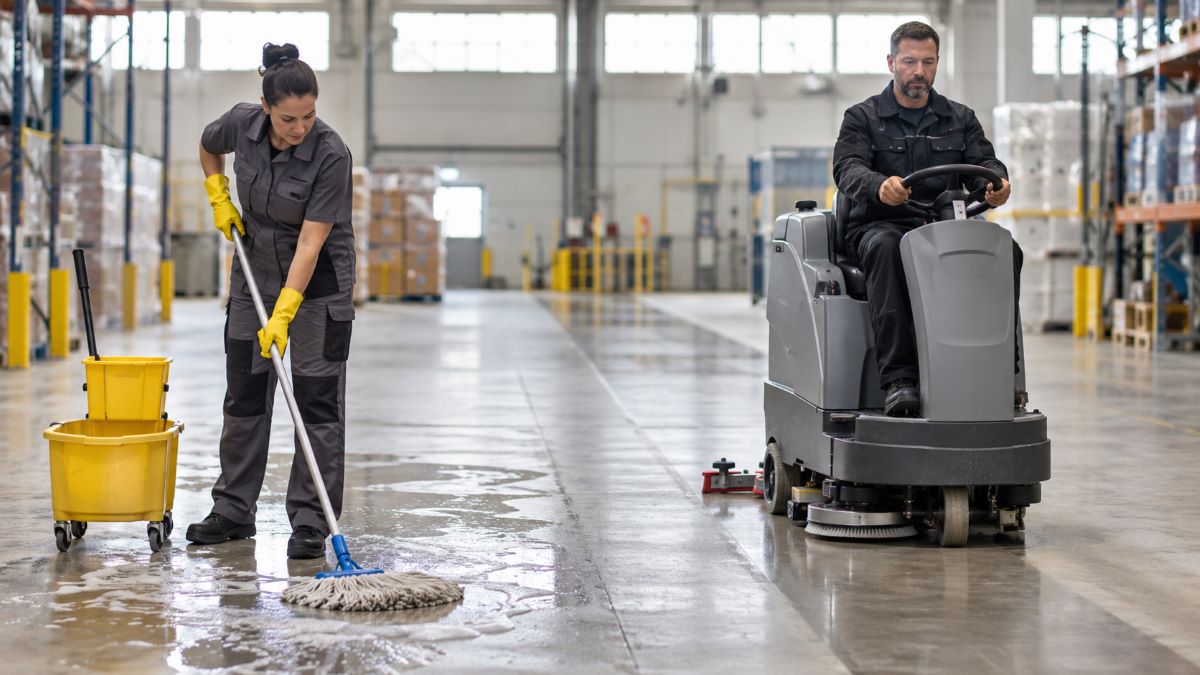
You have a 3,000 sq m hall, a hospital corridor or a warehouse that your team cleans every day with mops and buckets. Several people are busy for hours, the result differs from one shift to the next, and staffing costs rise every year. At some point the question comes up naturally: is it worth switching to mechanized cleaning?
The answer is not the same for every space. A 200 sq m office does not need the same professional cleaning equipment as a factory or a pedestrian square. There is, however, a simple way to decide: calculate what cleaning costs you now, estimate what it would cost with a machine, and compare. In this article we show how the calculation is done, which costs to include, and in which situations manual cleaning remains the right choice.
What manual and mechanized cleaning mean in practice
Manual cleaning uses hand tools: a mop, a bucket, a broom, a cloth, sometimes a small vacuum cleaner. Mechanized cleaning replaces part of the work with a machine that the operator drives or pushes.
A few terms come up often when machines are discussed:
- The scrubber-dryer applies the cleaning solution to the floor, scrubs it with brushes or pads and vacuums up the dirty water at the same time. The floor is almost dry after the machine passes.
- The sweeper collects dust and solid debris without water. It is used in spaces with a lot of dust, packaging or fine gravel.
- The single-disc machine has one rotating disc. It is used for intensive scrubbing, stripping or polishing.
- The spray-extraction vacuum cleaner sprays a solution into carpet or upholstery and extracts it immediately, together with the dissolved dirt.
The choice between these types depends on the surface area, the type of flooring and the kind of dirt. You can read about the selection criteria for each type in our article on floor scrubber-dryers. Here we deal with the question that comes before it: when does it make sense to move from manual to mechanized?
Manual cleaning: where it works well
Manual cleaning suits small spaces that are full of obstacles or have hard-to-reach floors: corners, stairs, offices with dense furniture, small bathrooms. The tool reaches wherever the person can reach. It requires no initial investment and no storage space for a machine.
The limits appear as the surface grows. Productivity depends heavily on the person and on fatigue. The water in the bucket gets dirty along the way, and on a large surface the result is hard to keep uniform. The physical effort is high, and staff turnover forces repeated training.
Mechanized cleaning: what changes
The machine performs the same type of operation across the entire surface, with the same working width and the same water and detergent consumption on every pass. One person covers a much larger area per hour than with a mop, and the result depends less on the operator’s fatigue. On the other hand, new costs appear: purchase or rental, batteries or fuel, consumables, service, and a place where the machine can be parked and charged.
How to calculate professional cleaning costs
Profitability is not judged by the price of the machine. It is judged by the total cost per square metre cleaned, compared between the two methods. For realistic professional cleaning costs, include the following elements.
The cost elements to include
- Labour. The number of hours per month multiplied by the fully loaded hourly cost of an employee: salary, contributions, leave, equipment. If you use an external service provider, use their hourly rate.
- Consumables. Detergent, water, mops, brushes, pads, collection bags.
- The machine. The leasing instalment, the rental or the depreciation of the purchase price over the estimated period of use.
- Energy and maintenance. Battery charging or fuel, plus periodic service and wear parts.
- Hidden costs. Time lost replacing staff, work accidents caused by wet floors, complaints about uneven results.
A worked example
The figures below are hypothetical, chosen as round numbers to show the method. They are not specifications or prices of a model from our catalogue. Replace them with the data for your space and with the productivity stated on the product page.
Assume a 1,500 sq m space, cleaned daily, 30 days a month. That gives 45,000 sq m cleaned per month.
| Item | Manual | Mechanized |
|---|---|---|
| Monthly surface | 45,000 sq m | 45,000 sq m |
| Productivity (hypothetical) | 250 sq m/hour | 1,000 sq m/hour |
| Working hours per month | 180 hours | 45 hours |
| Operator hourly cost (hypothetical) | 35 lei | 35 lei |
| Monthly labour cost | 6,300 lei | 1,575 lei |
| Consumables, energy, service | low cost | 800 lei |
| Monthly total | 6,300 lei | 2,375 lei |
In this example, the net monthly saving is 3,925 lei. If the machine had a purchase value of 40,000 lei (also an example figure), the investment would pay for itself in about ten months, without counting the cost of financing.
Two observations about a calculation like this:
- The hours saved do not disappear automatically from the budget. If the staff are moved to other tasks, the real benefit is the extra productivity, not a reduction in expenses. Decide beforehand where those hours go.
- The calculation must be redone with real figures. Productivity declared under ideal conditions is not achieved in a hall with pallets, columns and narrow passages. Ask for a test or a demonstration in your own space before you decide.
Profitability of cleaning equipment: when the investment is justified
There is no universal threshold of the type “above 1,000 sq m, buy a machine”. The profitability of cleaning equipment depends on four factors that work together.
- Continuous surface. A machine saves time on open floors with few obstacles. A 2,000 sq m hall without partitions is a different case from an office floor with 40 rooms.
- Frequency. A space cleaned daily pays off a machine much faster than one cleaned weekly.
- Hygiene requirements. Hospitals, schools, food facilities and hotels have procedures that require repeatable results. A machine with controlled water and detergent dosing helps you comply with them. For medical and educational spaces, see also our solutions for healthcare and education.
- Staff availability. If you find it hard to hire or keep cleaning staff, a machine reduces your dependence on headcount.
Signs that you have passed the threshold
If you recognise two or three of the situations below, it is worth doing the full calculation:
- cleaning one space takes more person-hours per day than you would like;
- the result differs visibly between shifts or between teams;
- you clean at night or in short windows, and the time is not enough;
- floors are left wet or slippery after cleaning, and the risk of injury worries you;
- you constantly spend money replacing mops, buckets and other manual consumables.
When manual cleaning remains the right solution
To be honest, there are situations in which we do not recommend a machine:
- spaces under a few hundred square metres, with dense furniture;
- occasional cleaning, for example once a week or after events;
- spaces with no room to store or charge a machine;
- floors that are difficult for any machine to access: stairs, narrow ramps, multiple steps.
In these cases, a machine would sit unused most of the time. Its cost would not be recovered, no matter how good it is. Combined solutions also exist and are more common than people think: the machine covers the large, open surfaces, while manual cleaning handles corners, stairs and hard-to-reach areas.
Buy, rent or choose a refurbished machine
Once the calculation shows that mechanization makes sense, the second decision follows: how do you acquire the machine? There are several answers to the same need, and each has advantages and limits.
| Option | When it fits | Limit to consider |
|---|---|---|
| New machine, purchased | Daily use, long term | Higher initial investment |
| Refurbished machine | Limited budget, regular use | The choice depends on what is available |
| Rental | Temporary need or a trial | The cost adds up over long use |
| Leasing or instalments | You want a new machine without the upfront outlay | Commitment for the duration of the contract |
A few benchmarks for the decision:
- A new machine is worth it when you use it intensively, for years, and you want the exact configuration suited to your space.
- Refurbished machines are reconditioned equipment. They can cover the same need on a smaller budget, if use is regular but not extreme. For details, see the page dedicated to refurbished machines.
- Rental suits a season of intensive cleaning, a general clean after renovation, or a trial of a few weeks before buying. The conditions are on the rental page.
- Leasing and payment in instalments spread the financial effort over time, without tying up your liquidity.
- Buy back and trade-in help if you already own a worn machine: you can sell it back or exchange it for a new model.
Concrete benefits of mechanized cleaning
The labour saving is only part of the argument. Other benefits show up in day-to-day operations:
- A uniform result. The machine covers the floor with the same working width and the same solution consumption, regardless of the shift or the person.
- A floor that dries quickly. A scrubber-dryer collects the water while it works. The area can be used again shortly afterwards, which matters in a hospital or in a shop open to the public.
- Less physical effort. The operator drives or pushes the machine instead of carrying buckets and wringing out a mop for hours.
- Schedulable cleaning. A battery-powered machine can work in windows when the space is empty, for example in the evening or at night, without interrupting activity.
- Control over consumption. Water and detergent are dosed, so the expense can be measured and planned.
- The possibility of automation. For large, repetitive spaces there are also autonomous robots for floor cleaning, an option worth evaluating if the routes are predictable.
For outdoor and public spaces, the logic is the same. A mayor responsible for cleaning a pedestrian square or a car park administrator looks at working hours, consumption and team availability, just like a warehouse manager. For this type of space, you will find more information in the section on municipalities and public spaces.
How Komarom helps in this process
Our experience in professional cleaning equipment goes back to 2008. We work with internationally recognised manufacturers: IPC, Dr. Gansow GMATIC, Dulevo, Green Machines and Du Puy. Our role does not end at delivery, and our approach is to recommend the machine that suits your space and workload, not the most expensive one.
Specifically, you can ask for our help at the following stages:
- Advice before purchase. We discuss the surface area, the type of flooring, the cleaning frequency and the working schedule. Based on these we recommend the type of machine and, where appropriate, we tell you that a machine is not justified.
- Comparing the options. We help you compare buying, renting, leasing and refurbished machines, with the advantages and limits of each.
- Free advice on funding. If the funding comes through SEAP (the Romanian public procurement system), AFIR or European funds, we offer free consultancy in preparing the purchase.
- Spare parts, consumables and service. Professional detergents, batteries, chargers and spare parts. After-sales technical assistance is described on the service and maintenance page.
A well-chosen machine is worth little if it reaches the hall without working batteries, without the right detergent or without anyone to repair it. That is why we treat the purchase as a complete process, not as an isolated sale.
Conclusion: decide with the figures of your own space
Mechanized cleaning is not better in every situation, and manual cleaning is not obsolete. The right decision starts from a simple calculation: how much a cleaned square metre costs you today, how much it would cost with a machine, and how long it takes to recover the difference. If the space is large, continuous and cleaned often, an investment in a professional machine is usually justified relatively quickly. If the space is small or cleaned rarely, rental or manual cleaning remain more reasonable options.
For a correct assessment of the profitability of cleaning equipment, you need three pieces of data: the surface area, the cleaning frequency and the current cost of labour. With them, any decision becomes a comparison of figures, not an assumption.
Let’s talk about your space
If you want to check whether a machine is justified in your case, you can write to us or call us. You send us the basic details about the space and we analyse it together, with no obligation to buy. You can request a quote or ask us for a recommendation, including for rental or for a refurbished machine.